

Caste-Based Remarks Inside Private Residences Are Not ‘Within Public View’ Under the SC/ST Act: SC
 Copy Link
 Share
Share Save
Save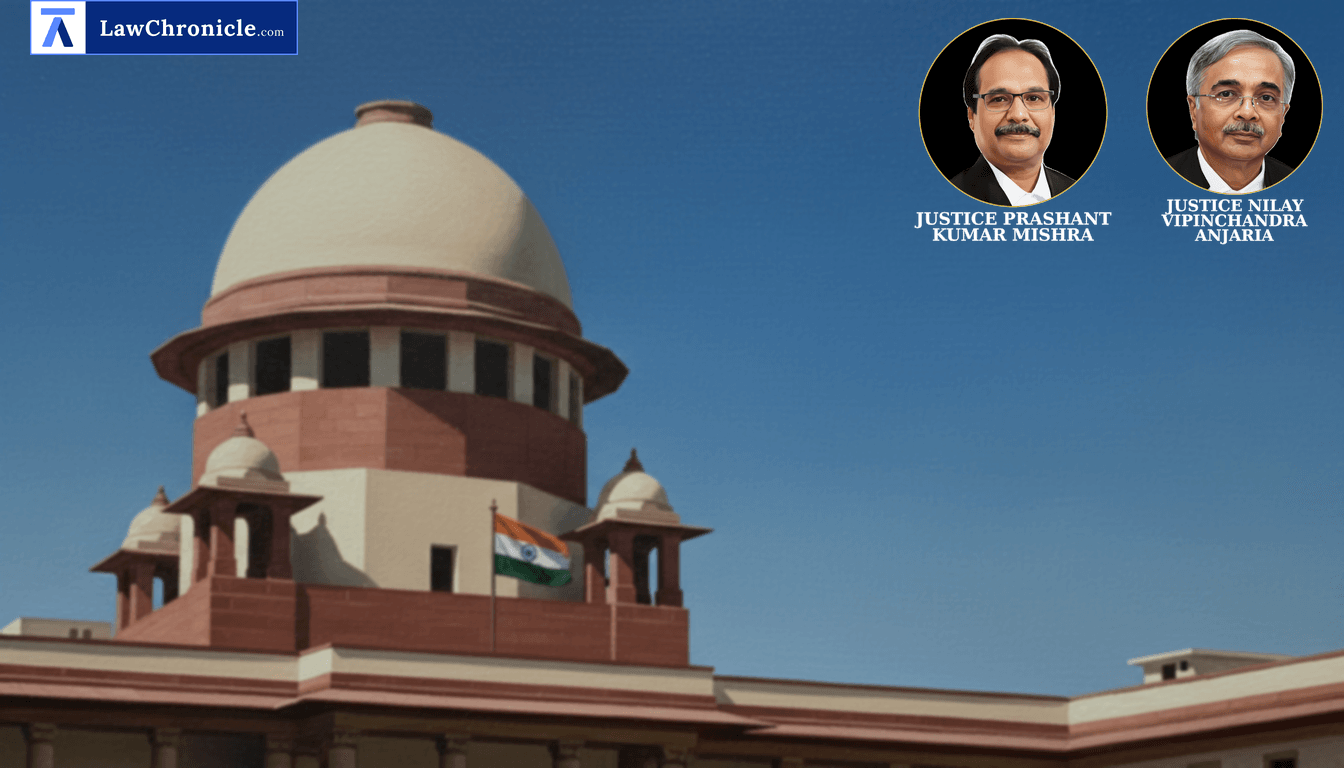
The Supreme Court has clarified that for an offense to be constituted under the Scheduled Castes and Scheduled Tribes (Prevention of Atrocities) Act, 1989, the alleged insult or abuse must occur in a place 'within public view', emphasizing that private residential spaces do not naturally meet this criteria.
A bench of Justice Prashant Kumar Mishra and Justice N.V. Anjaria set aside the orders of the Delhi High Court and the Trial Court, which had framed charges against family members involved in a property dispute. The Court noted that the primary requirement of the incident being visible or audible to the public was conspicuously absent in the First Information Report (FIR).
The Necessity of 'Public View' for SC/ST Act Offenses
The Court observed that the expressions 'public place' and 'place within public view' are distinct. Referring to judicial precedents like Swaran Singh and Others vs. State through Standing Counsel and Another ( "(2008) 8 SCC 435": 2008 CaseBase(SC) 1248) and Hitesh Verma vs. State of Uttarakhand and Another ( "(2020) 10 SCC 710": 2020 CaseBase(SC) 649), the Court reiterated that while a private place could be within public view if visible to outsiders, an incident occurring within the four walls of a house without the presence of independent public members does not attract the specialized penal provisions of the Scheduled Castes and Scheduled Tribes (Prevention of Atrocities) Act, 1989.
The Court, in its reasoning, observed: "The requirement that the place must be one 'within public view' can be said to be substantiating the other elements of the offence under the SC/ST Act. It is therefore a sine qua non for making out the offence under the SC/ST Act."
Regarding the charges under Section 506 of the Indian Penal Code, 1860, the Court found that the essential 'intent to cause alarm' was missing. It further noted that since the parties were family members embroiled in a property dispute, the continuation of criminal proceedings would amount to an abuse of the process of law.
Background:
The dispute arose between three brothers and their wives over properties left by their late father. The complainant (Respondent No. 2) alleged that Appellant No. 1, his brother's wife who belongs to an upper caste, regularly hurled casteist slurs like 'chura' and 'chamar' from her balcony. On January 28, 2021, an altercation reportedly took place when the appellants allegedly tried to break open the complainant’s house. The FIR was registered under Sections 3(1)(r) and 3(1)(s) of the Scheduled Castes and Scheduled Tribes (Prevention of Atrocities) Act, 1989 and Section 506 read with Section 34 of the Indian Penal Code, 1860.
The Trial Court framed charges in November 2022, and the Delhi High Court dismissed the revision petition in August 2024, stating that a 'mini-trial' was not required at the framing stage. However, the Supreme Court, relying on the 'acid test' from State of Haryana and Others vs. Bhajan Lal and Others ( "1992 Supp (1) SCC 335": 1990 CaseBase(SC) 91), held that if the FIR's contents do not disclose the necessary ingredients of an offense, it must be quashed. The Court also cited Karuppudayar vs. State represented by the Deputy Superintendent of Police, Lalgudi Trichy and Others and Ramesh Chandra Vaishya vs. State of Uttar Pradesh and Another to establish that the absence of a 'public view' element is fatal to the prosecution's case under the Scheduled Castes and Scheduled Tribes (Prevention of Atrocities) Act, 1989.
Case Details:
Case No.: CRIMINAL APPEAL NO. 2446 OF 2026
NeutralCitation: 2026 INSC 468
Case Title: GUNJAN @ GIRIJA KUMARI AND OTHERS VERSUS STATE (NCT OF DELHI) AND ANOTHER
Appearances:
For the Petitioner(s): Mr. Avadh Bihari Kaushik, Advocate
For the Respondent(s): Ms. Archana Pathak Dave, Additional Solicitor General; Mr. Mukesh Kumar Maroria, Advocate-on-Record
Source: 2026 CaseBase(SC) 411
 Breaking News