

Delhi HC: Illegal Forfeiture of Earnest Money Cannot Be Shielded by Non-Voluntary Settlement
 Copy Link
 Share
Share Save
Save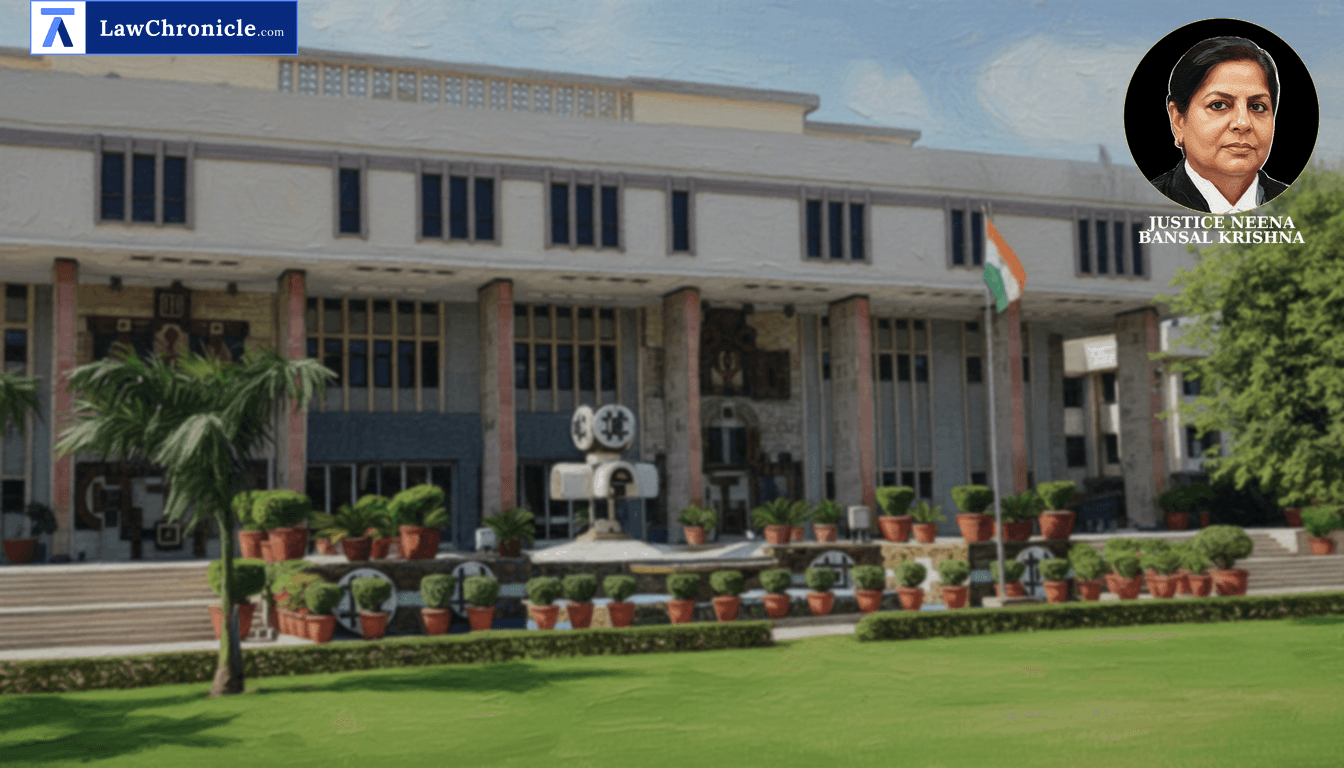
In a significant ruling protecting homebuyers from coercive practices, the Delhi High Court has held that developers cannot retain earnest money under the guise of a 'full and final settlement' if the cancellation of allotment was illegal and the settlement was executed under duress.
Justice Neena Bansal Krishna, presiding over the matter, dismissed an appeal filed by a real estate developer against a trial court decree that had ordered the refund of ₹18,00,000 to the respondents. The court observed that the developer occupied a dominant position and effectively coerced the allottees into accepting a partial refund after arbitrarily canceling their villa allotment.
Court's Analysis on Construction-Linked Payments and Service of Demand
The dispute centered around whether the allottees had defaulted on payments. The developer argued that the payment plan was time-linked, while the respondents contended it was construction-linked. Upon perusing the agreement, the Court found that while a timeframe was indicated, payments were explicitly tied to the actual progress of construction. The Court noted that the developer failed to provide any construction schedule or prove the stage of work at the site.
Furthermore, the Court addressed the lack of proof regarding the service of demand notices. While the developer produced copies of letters, it could not provide any postal or courier receipts as mandated by the agreement. The Court held: "The responsibility to pay instalments was, first, linked to construction progress and, second, contingent upon receiving a Letter of Demand. The Defendant has miserably failed to prove that the demands were raised in correlation to the construction carried out at the site, or that these Demand Letters... were ever served upon the Plaintiffs."
Invalidity of Settlement Signed Under Coercion
A pivotal issue was whether a refund of ₹44 Lakhs accepted by the plaintiffs extinguished their right to claim the remaining ₹18 Lakhs. The Court applied the principle of 'necessitas non habet legem' (necessity knows no law), noting that the developer held the allottees' entire investment of ₹62 Lakhs and used its superior bargaining power to force a settlement.
The Court, in its reasoning, observed: "The learned District Judge correctly observed that the Plaintiff, when pitted against a large developer with superior bargaining power, was effectively coerced into accepting the Rs. 44 lakhs offered by the Defendant. The court rightly concluded that the Plaintiff’s acceptance and even the encashment of the cheque, was vitiated by coercion and undue influence."
Legal Principles Governing Forfeiture of Earnest Money
The Court reiterated that under Section 74 of the Indian Contract Act, 1872, any party seeking to forfeit money must prove actual loss or damage. In this case, the developer failed to show any financial loss and instead likely profited by selling the property to a third party. Referring to the Code of Civil Procedure, 1908 and Order XLI Code of Civil Procedure, 1908, the Court upheld the recovery suit.
Regarding the legal standards for forfeiture and settlement, the court examined several precedents including Kailash Nath Associates vs. DDA and Satish Batra vs. Sudhir Rawal ( "(2012) 132 DRJ 705": 2012 CaseBase(SC) 421) for the principles of earnest money, and Ambika Construction vs. Union of India and MD, NTPC Ltd. vs. Reshmi Constructions regarding coercive bargaining. The Court noted that since the breach was on the part of the developer, the forfeiture was entirely unjustified.
Background:
The case arose from an Agreement to Sell executed in February 2008 for a villa in the 'Rosewood City' project in Gurgaon for ₹2.5 Crores. The plaintiffs had paid ₹62 Lakhs, but the developer unilaterally cancelled the allotment in March 2009, alleging default in instalments. The plaintiffs alleged that the construction was slow and used sub-standard materials. After the cancellation, the developer refused a full refund, eventually forcing the plaintiffs to sign a settlement for ₹44 Lakhs while forfeiting ₹18 Lakhs. The plaintiffs accepted the cheque 'under protest' and filed a suit for recovery. The trial court ruled in favor of the plaintiffs, leading to the present appeal by the developer.
Case Details:
Case No.: RFA 37/2020
Case Title: M/S R. C. SOOD & CO. DEVELOPERS PVT. LTD. (EROS GROUP) vs. SHRI SHARAD MAHESHWARI & ANR.
Appearances:
For the Petitioner(s): Mr. Vikas Mishra, Mr. Kartik Magar Karti, Mr. Sanchit Gawri and Mr. Krishna Dev Yadav, Advocates.
For the Respondent(s): Mr. Manish Kaushik and Mr. Mishal Johari, Advocates.
Source: 2026 CaseBase(DEL) 335
 Breaking News