


SC Clarifies Primacy Of Government Grants Act Over Rent Control Law
 Copy Link
 Share
Share Save
Save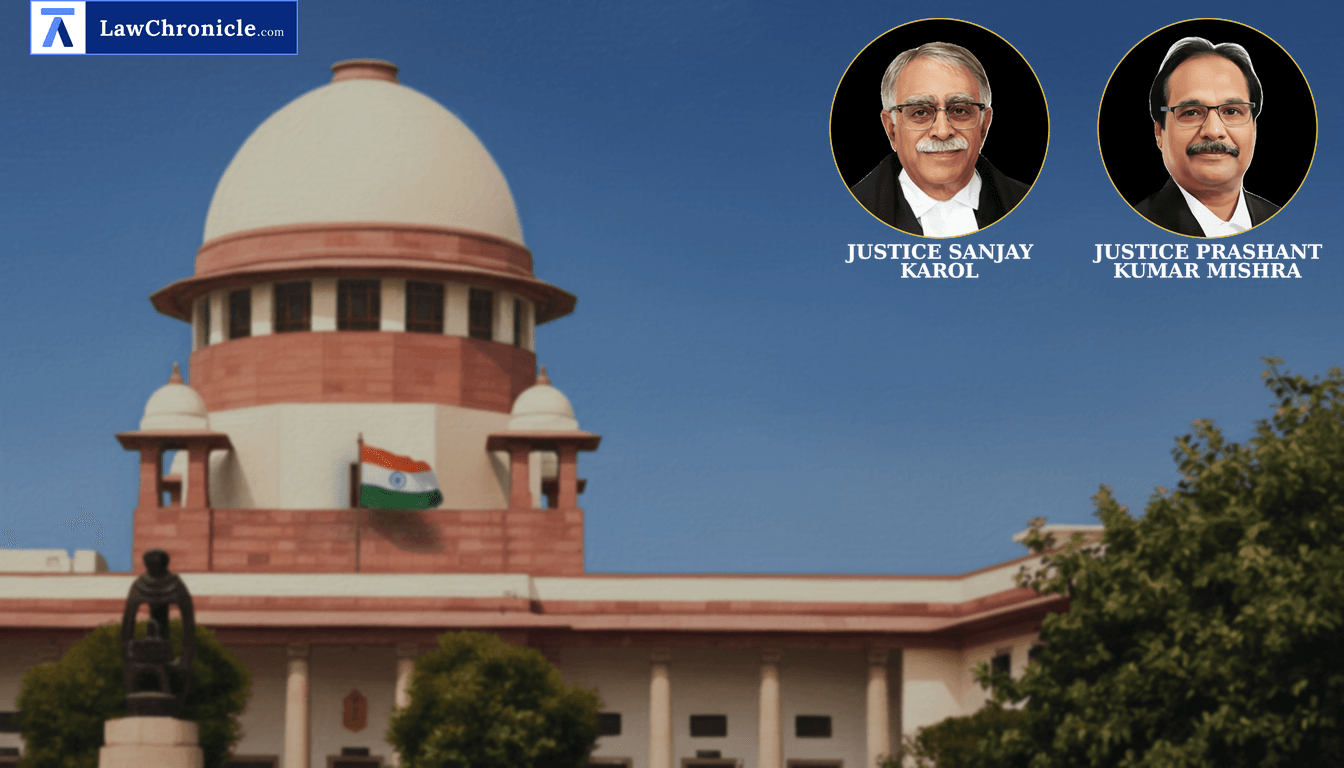
The Supreme Court recently considered an appeal questioning the nature of the Union of India’s occupation of residential premises at Sujan Singh Park. The matter, heard by a bench of Justice Sanjay Karol and Justice Prashant Kumar Mishra, turned on whether such occupation flowed exclusively from a perpetual lease granted as a Government Grant or whether it bore the characteristics of a landlord tenant relationship, thereby attracting eviction proceedings under Section 14(1)(a) of the Delhi Rent Control Act, 1958.
The Court allowed the appeal and held that the tenancy law invoked by the respondent did not govern the holding in question because the perpetual lease emanated from a Government grant. The Court observed that the dispute turned on the legal character of the instrument and whether the statutory protection in the Government Grants Act, 1895 displaced operation of the Delhi rent regime; it concluded that it did.
The Court, in its reasoning, observed: "Upon an anxious consideration of the statutory scheme of the GG Act and the authoritative pronouncements of this Court, the legal position that emerges is no longer res integra. Section 3 of the GG Act embodies a clear legislative mandate that every Government grant shall take effect according to its tenor, notwithstanding any rule of law, statute or enactment to the contrary. The expression “any rule of law, statute or enactment” in the provision is of the widest amplitude and admits of no restrictive construction."
Background
The dispute arose from a perpetual lease deed dated 26.04.1945 executed by the Governor General in Council in favour of the predecessor of the respondent for about 7.58 acres at North and South Sujan Singh Park, New Delhi, under which residential flats and ancillary accommodation were to be constructed and certain rights of governmental occupation and requisition were reserved. Several flats and servant quarters were later occupied by the Union for housing officials. The respondent alleged default of rent and instituted eviction proceedings under the Delhi Rent Control Act, 1958, while the Union contended that the occupation flowed from the perpetual lease deed and was governed by the Government Grants Act, 1895, thereby excluding the operation of the Transfer of Property Act, 1882 and related consequences of ordinary tenancy law.
Lower fora treated the relationship as one of landlord and tenant and sustained eviction; the High Court affirmed that view. Before this Court, the Union relied on authorities such as Municipal Corporation of Delhi vs. Pradip Oil Corporation and Another, Union of India and Another vs. Dinshaw Shapoorji Anklesari and Others ( "(2014) 14 SCC 204": 2014 CaseBase(SC) 459) and Azim Ahmad Kazmi and Others vs. State of Uttar Pradesh and Another to contend that rights under a Government grant were to be governed exclusively by the tenor of the grant, while the respondent relied upon the proposition that a substantive tenancy had emerged and pointed to the proviso in Section 3(b) of the Delhi Rent Control Act, 1958. The Court reviewed the scheme of the Government Grants Act, 1895, noting that Section 2 excluded the Transfer of Property law from applying to Government grants and that Section 3 gave primacy to the provisions, restrictions and conditions of a grant "according to their tenor".
The Court explained that the essential enquiry was the legal character of the instrument and that, once identified as a Government grant, the statutory consequences under the Government Grants Act, 1895 followed; the DRC Act did not apply to the holding in issue. The Court noted reliance placed before it on precedents and explained that while some earlier decisions addressed narrower questions, subsequent authoritative pronouncements such as Pradeep Oil Corporation vs. Municipal Corporation of Delhi and Another ( "(2011) 5 SCC 270": 2011 CaseBase(SC) 42) and Tata Steel Limited vs. State of Jharkhand and Others supported the conclusion that a grant under the Government Grants Act, 1895 insulated stipulations contained in the grant from inconsistent statutory regimes. The Court further observed that "The grant must operate according to its tenor, and its silence cannot be converted into a ground of forfeiture." Accordingly, the Court held that eviction proceedings instituted under the Delhi Rent Control Act, 1958 were not maintainable in the circumstances and that the respondent’s remedy was confined to recovery of arrears in accordance with the terms of the grant.
The Appeal was allowed and the impugned judgment of the High Court dated 08.01.2020 in CM(M) No. 293 of 2008 was set aside. The Court clarified that its conclusion did not preclude the respondent from pursuing appropriate civil remedies in accordance with law.
Case Details:
Case No.: CIVIL APPEAL NO. 4686 OF 2026
NeutralCitation: 2026 INSC 406
Case Title: UNION OF INDIA VERSUS SIR SOBHA SINGH AND SONS PVT. LTD.
Appearances:
For the Petitioner(s): Mr. K.M. Nataraj, learned ASG
For the Respondent(s): Mr. P.S. Patwalia, learned senior counsel
Source: 2026 CaseBase(SC) 353
 Breaking News