

SC: No Maintenance If DNA Test Proves Non Paternity
 Copy Link
 Share
Share Save
Save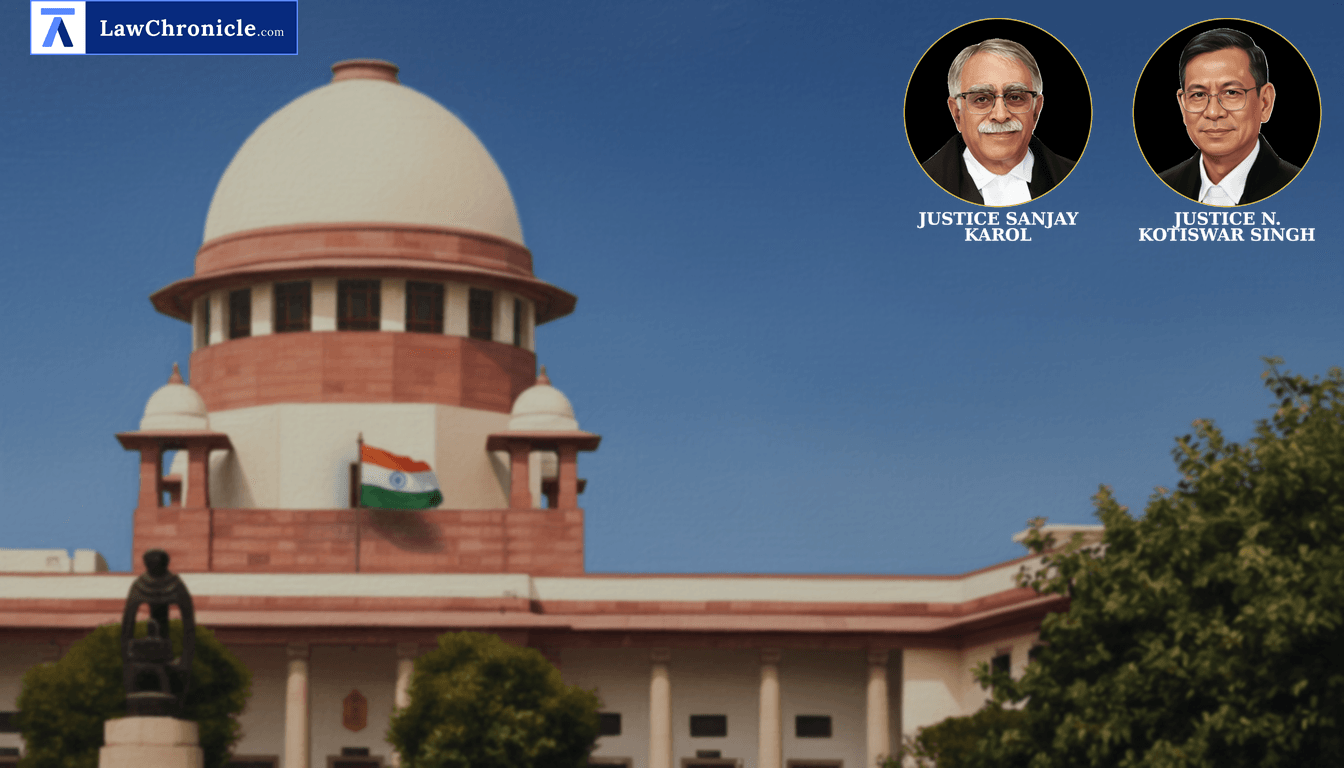
The Supreme Court of India has reaffirmed that when a DNA test report, conducted on the direction of the court, is available on record and conflicts with the presumption of conclusive proof of the legitimacy of the child, the DNA test report cannot be ignored. A bench of Justice Sanjay Karol and Justice Nongmeikapam Kotiswar Singh heard a criminal appeal in which a mother challenged the denial of maintenance to her daughter and the refusal to hold the respondent liable as the biological father. The appeal arose from orders of the Metropolitan Magistrate and the District and Sessions Judge in New Delhi and engaged the scope of Section 112 of the Indian Evidence Act,1872 and the proceedings under Section 12 of the Protection Of Women From Domestic Violence Act, 2005.
The Court summarised its principal holding by noting that where a court-directed DNA report had attained finality and was on the record the presumption under Section 112 of the Indian Evidence Act,1872 could not operate to the prejudice of the person shown by scientific evidence not to be the biological parent. The Court observed, in language taken from earlier precedent, that "Despite technological advancements by leaps and bounds, this presumption has been retained to save any child from the stigma of illegitimacy."
The Court, in its reasoning, observed: “This Court expresses concern about the child whose dispute of parentage had made its way up to us. Even though the High Court has correctly remanded the matter of the appellant’s maintenance to be decided afresh by the Trial Court, we acknowledge that even if a revised amount is awarded as per law, the difficulties for the child will persist.”
Background
The appellant had worked as domestic help in the respondent's household, parties had lived together and married in March 2016, and a child was born on 1 April 2016. The appellant filed an application under Section 12 of the Protection Of Women From Domestic Violence Act, 2005 seeking interim maintenance for herself and the child, protection orders and return of stridhan; the respondent denied the allegations and sought a court-directed DNA test to determine paternity. The Trial Court ordered DNA testing, and the report dated 8 May 2017 recorded that the respondent was not the biological father. The Trial Court refused interim maintenance to the child on that basis and on findings of alleged concealment of income; the First Appellate Court upheld the Trial Court on concealment and noted that maintenance for the child was not pressed on appeal. The High Court examined the presumption under Section 112 of the Indian Evidence Act,1872, observed that the presumption protects legitimacy but that it did not apply where a conclusive DNA report was on record, quashed the grant of child maintenance but remanded the mother's personal claim for fresh consideration by the Trial Court.
In reaching its conclusion the Court reviewed earlier authorities and balancing approaches: it referred to the cautionary approach in Dukhtar Jahan v. Mohd. Farooq and the guidance on DNA testing in Goutam Kundu v. State of W.B., accepted the proposition articulated in Nandlal Wasudeo Badwaik v. Lata Nandlal Badwaik that scientific proof may prevail over statutory presumptions where it is on record, and considered the approaches in Dipanwita Roy v. Ronobroto Roy, Aparna Ajinkya Firodia v. Ajinkya Arun Firodia and Ivan Rathinam v. Milan Joseph which were relied upon to explain the competing concerns of a child's identity, privacy and the risk of social stigma. The Court held that on the facts of the present appeal the High Court did not commit error in denying maintenance to the daughter on account of the final DNA report, and dismissed the appeal.
The Court expressed concern for the child's welfare and directed the Secretary, Women and Child Development, Government of the NCT of Delhi, to depute an experienced officer to visit the appellant's residence, ascertain the child's condition with regard to education, nutrition, health and basic material needs, and to take remedial measures where deficiencies were found. The matter of the appellant's maintenance was remanded to the Trial Court for fresh determination in accordance with law.
Case Details:
NeutralCitation: 2026 INSC 399
Case Title: NIKHAT PARVEEN @ KHUSBOO KHATOON v. RAFIQUE@SHILLU
Source: 2026 CaseBase(SC) 345
 Breaking News